
Small-Batch Holiday Merch: A Practical Guide for Local Businesses
Small-batch holiday merch starts with a clear purpose, a focused product selection, and quantities tied to actual interest. Choose the items your customers or team will use, collect sizes before committing to apparel, and approve a finished sample before placing the larger order. For a McKinney retailer preparing for a holiday market, store campaign, or staff celebration, those decisions matter more than launching a large collection. A manageable first run gives you room to check the design, learn which options people choose, and decide whether a reorder makes sense. Choose one main product, confirm the design and production method, and use preorders to establish quantities where practical. Test the actual product before scaling. Then work backward from your event date, allowing separate time for artwork approval, production, shipping or pickup, and any pressing or packaging you will handle yourself. Start by deciding what the merchandise needs to accomplish. Products for retail sales, customer giveaways, and employee gifts involve different quantity decisions. For retail merchandise, look at previous sales and customer requests. For staff gifts, collect the recipient count and preferences directly. For a new market product, decide how much unsold inventory you can reasonably carry. Keep the first assortment easy to explain. One design on one shirt color is simpler to manage than several designs across multiple colors and sizes. Add another option when it serves a distinct need, rather than expanding the collection simply to offer more choice. These holiday merch ideas illustrate different ways a local business could build a focused collection. Imagine a neighborhood gift shop offering a shirt with an original winter illustration and a small shop identifier. Customers could reserve their size before the shop commits to the run. Show the design on the proposed shirt color and publish the size chart. Offer one main print placement to keep approvals straightforward. If the shop has no pressing equipment, DTF Dallas’s Custom T-Shirt service provides a finished-shirt ordering path. For a McKinney holiday market, consider a fabric tote featuring an original neighborhood-inspired illustration. A design without a specific year could remain useful after the event. A seller with a heat press could test a DTF Transfer on the exact tote before ordering repeats. Check that the material is compatible and that handles, seams, and pockets leave a flat pressing area. Set the initial quantity from reservations and a deliberate allowance for market sales. A cap with a compact stitched logo offers a different direction for employee gifts. Confirm the cap style, color, recipient count, and logo placement before requesting the proof. The Embroidery service is produced in the Richardson shop and has no minimum quantity for custom pieces. Allow time for proof approval and the five-business-day turnaround, plus shipping if needed. The turnaround covers order readiness, not arrival. The useful starting point depends on your equipment and the finished result you want. DTF Dallas supplies ready-to-press DTF Transfers that arrive printed, cured, and prepared for application. You can decorate compatible blanks without purchasing a printing system or handling adhesive powder. Start with a single transfer when testing your own artwork. Once the design is approved, DTF Transfer gang sheets can consolidate several designs or repeats. Use the DTF Gang Sheet Builder with your actual dimensions and quantities. Arrange repeats or different designs on the same sheet, cut them apart when they arrive, and apply each design to its intended item. Compare the sheet cost with the number of usable designs before ordering. Holiday merch preorders can turn interest into a clearer production count. A social-media reaction may suggest curiosity, but it does not tell you which size someone will purchase. Use a simple sequence: 1. Show the proposed product. Include the garment color, design placement, size chart, and a representative image or sample. Separate reserved stock from event stock. Keep customer orders identifiable when the products arrive. For example, suppose you receive 18 confirmed preorders and choose to carry six additional shirts for walk-up sales. That creates a plan for 24 saleable shirts, with any sample accounted for separately. Those numbers illustrate the calculation; they are not a recommended stock ratio. Keep customers informed if timing changes. Preorders improve the information available for planning, but cancellations and fulfillment problems can still occur. Prepare the artwork at its intended print dimensions. DTF Dallas recommends a transparent PNG at 300 DPI; PDF files are also accepted. CMYK color settings are recommended to help reduce differences associated with RGB files. Submit the design in its normal, readable orientation without mirroring it. Remove unwanted backgrounds before uploading because white or colored background areas left in the file will print. Review spelling, small text, and placement carefully. An artwork review does not replace your approval of the design itself. For your own graphic, DTF Transfers by Size offers a single-transfer testing route. Use the actual garment style, color, and application equipment planned for the run. Before decorating your sample, watch DTF Dallas’s heat press application tutorial or home iron application tutorial for the equipment you will use. Follow the matching video for heat settings and application technique, then test the process on your chosen garment before preparing the full run. Check the sample for: Correct artwork, dimensions, and placement. 1. Readable lettering and acceptable color. 2. Clean release and fully attached edges. 3. Scorching, distortion, or other garment damage. 4. Unusual lifting or cracking during normal movement. Record the settings and photograph the result. Document laundering observations using the care instructions for the finished item. First-time customers can request the Free Sample Pack, containing four fabric DTF Transfers and one UV DTF Transfer for a compatible hard surface. A lower unit price can still produce a larger total commitment if it requires buying merchandise you do not expect to use. Compare the same product, quantity, artwork size, and number of placements. Include the applicable cost of blanks, decoration, setup or digitizing, samples, packaging, and fulfillment. For transfers you apply yourself, account for pressing labor and the products used during testing. Ask which charges recur on a reorder. Keep the approved artwork version, product details, and quote together so a later order can be compared accurately. For embroidered holiday gifts, use the embroidery order form and email contact for pricing questions. Your merchandise needs to be ready before setup begins. Work backward through packaging, inspection, any pressing you will perform, fulfillment, and artwork approval. DTF Dallas offers fast shipping options and free local pickup, giving McKinney businesses a choice of how to receive their holiday merchandise. Confirm the available timing for your product and order before setting a customer collection date. If you choose shipping, allow for production and carrier transit as separate stages. Review the Shipping Policy for current options and conditions when planning your order. Local collection can remove carrier transit from your plan. McKinney organizers can select Lucas or another available location at checkout. Review Pickup Locations, confirm your chosen address, and wait for the separate ready-for-pickup notification before traveling. Bring your order confirmation and follow the collection instructions in that notification. Keep a practical buffer for checking and packing the finished merchandise. There is no single quantity that makes sense for every business. Base the run on confirmed recipients or orders, realistic event stock, your budget, and the supplier’s product-specific terms. Include a year when it adds meaning to the event or keepsake. Leave it off when you want remaining products to stay relevant beyond that season. A different fabric, color, coating, or construction can change the result. Test the replacement before treating it as interchangeable with the approved product. Write down the product, quantity, sizes, artwork dimensions, production method, and date the merchandise must be ready. That short brief turns a seasonal idea into an order you can evaluate. DTF Dallas’s Holiday DTF Transfers & Custom Shirts page brings together the main seasonal ordering paths. Choose the route that fits your equipment and workload, approve the sample or proof, and commit to a quantity you can explain.
Small-Batch Holiday Merch: A Practical Guide for Local Businesses
Quick Answer
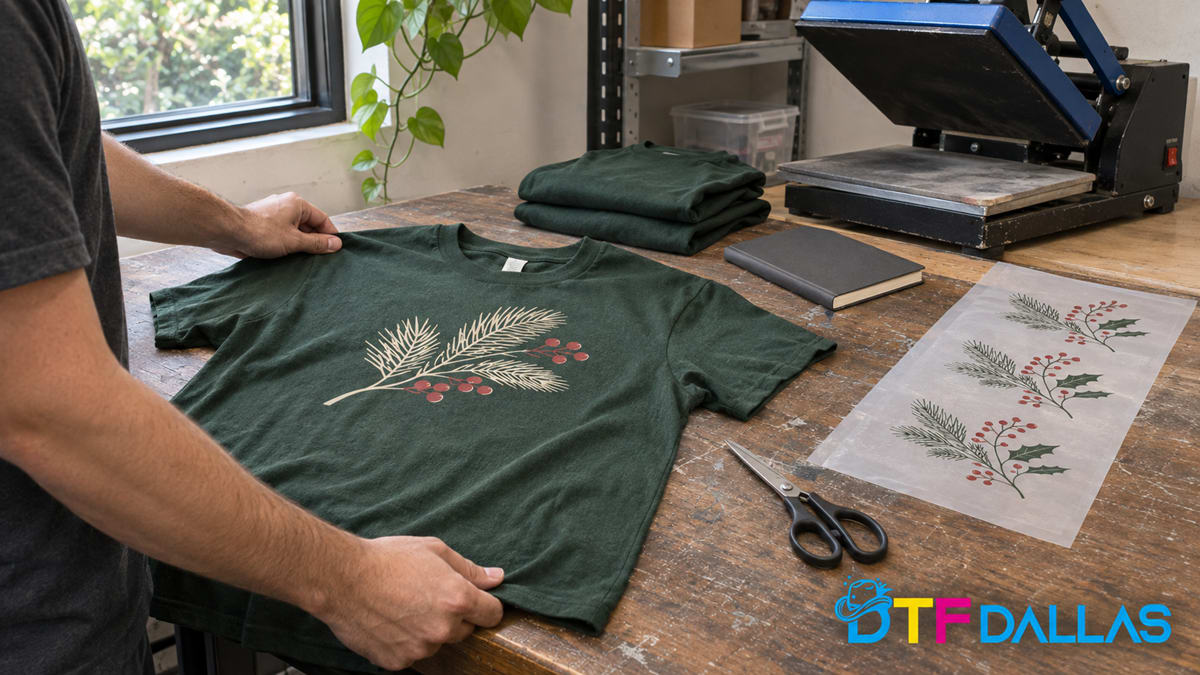
Choose One Purpose and a Focused Assortment
Three Holiday Merch Concepts to Make Your Own
A Limited Holiday Tee for a Neighborhood Shop
A Market Tote with a Reusable Local Design
A Small-Logo Cap for Staff Thank-You Gifts
Choose How the Merch Will Be Made
Use Preorders to Set Quantities
2. Explain the terms. State the order deadline, payment arrangement, and expected shipping or collection timing.
3.Record each selection. Capture the customer’s contact details, product, size, color, and quantity.
4.Close and check the totals. Resolve incomplete orders before submitting the production quantity.Prepare Artwork and Approve a Sample
Compare the Whole Order
Plan Backward from the Event Date
Frequently Asked Questions
Does small-batch mean a specific number of products?
Should every design include the holiday year?
Can I switch to a different blank after approving the sample?
Turn Your Shortlist into a Clear Order
Images